Finding the right digital product design agency is harder than it looks. Every agency says the same things: "we build beautiful products," "we are user-first," "we deliver results." But when you are about to spend real money, you need more than a polished pitch.
This list cuts through it. We reviewed 10 agencies based on real portfolio work, verified client outcomes, pricing transparency, and who each agency actually serves best. No agency paid to be here.
What we evaluated:
- Portfolio depth and digital product design case studies
- Client results with real numbers, not vague claims
- Engagement models and pricing transparency
- Who each agency is genuinely the best fit for
TL;DR: Which one do you need?
- Startups & AI: MetaLab (Speed) or Presta (AI-Native).
- For Enterprise & Scale: Work & Co (Global) or Frog (Hardware/IoT).
- For Research & Systems: UX Studio (Data) or Ramotion (Design Systems).
- For Design Aesthetics: Clay (High-end) or Instrument (Storytelling).
- For Partners: Panze (White Label only).
The 10 Best Digital Product Design Agencies in 2026

Here is what we found after going through each agency's actual work, client results, and published case studies.
Table:
| Agency | Best For | Model | Pricing | Notable Clients |
|---|---|---|---|---|
| Panze | White label SaaS and app design for agencies | Project, retainer, sprint | Custom | Agencies and studios |
| Clay | Premium tech branding and high-end UX | Project-based | From $50K | Meta, Google, Slack, Stripe |
| MetaLab | Zero-to-one product launches | Project-based | From $100K | Slack, Coinbase, Suno AI |
| Work & Co | Global enterprise scale | Project-based | Custom | IKEA, Apple, Delta Air Lines |
| UX Studio | Data-backed SaaS and research | Hourly / project | $25–49/hr | B2B SaaS companies |
| Ramotion | B2B design systems | Project-based | $150–199/hr | Netflix, Adobe, Salesforce |
| IDEO | Human-centered strategy and innovation | Project-based | Custom | NHS, Ford, Samsung |
| Instrument | Brand storytelling and digital campaigns | Project-based | Custom | Nike, Pinterest |
| Frog | Physical-digital integration and IoT | Project-based | Custom | Apple, GE, Audi |
| Presta | Agentic AI and startup growth | Project / sprint | Custom | AI startups |
Use this table to narrow down your shortlist fast. Then read the full review for any agency that fits your situation before you reach out.
1. Panze: The Only White Label Digital Product Design Agency for SaaS and Apps
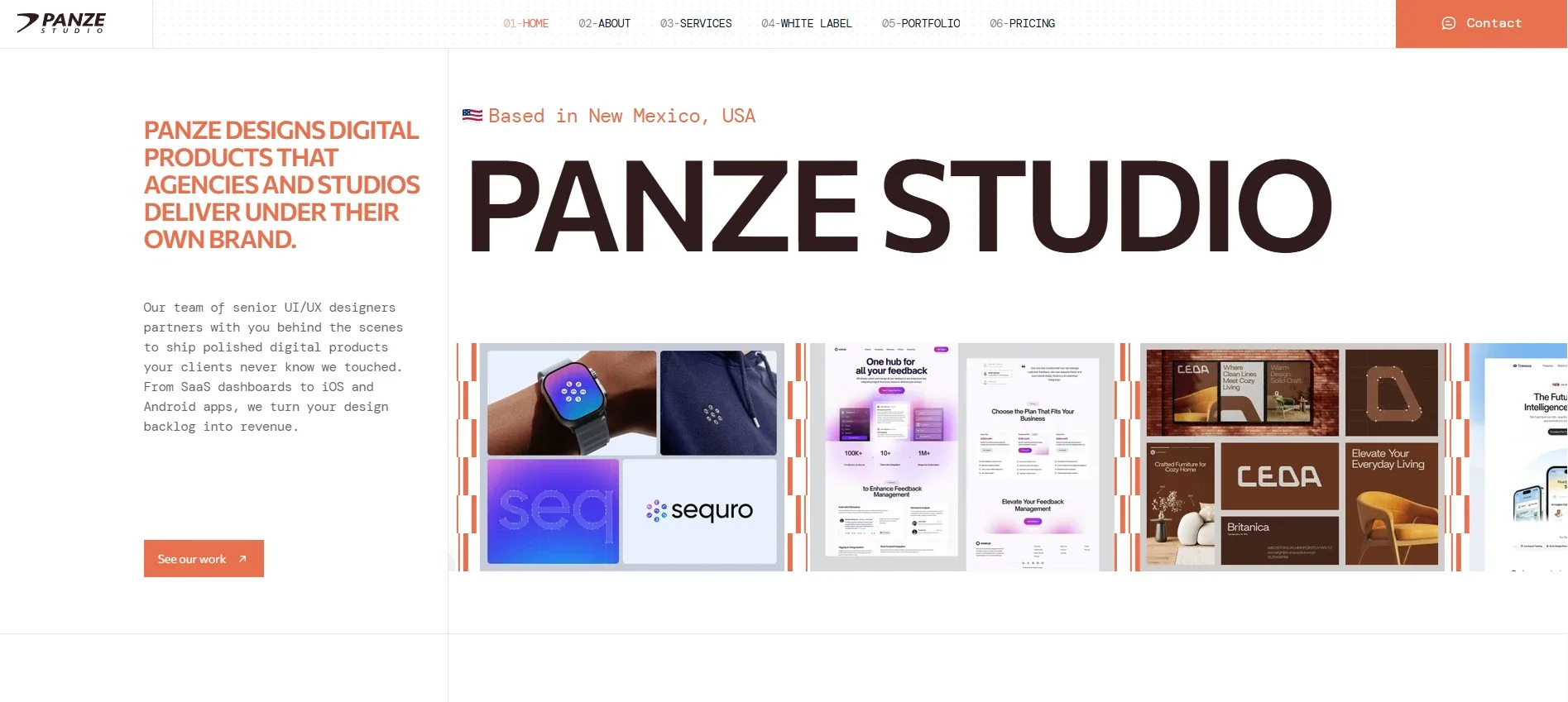
Here is the thing most lists miss. Most digital product design agencies take direct client work. Most white label agencies handle websites and branding. Panze is the only agency built at the exact intersection of both. They work exclusively on SaaS and app design, for agency and studio partners, and never for end clients directly.
Panze is a registered LLC based in Albuquerque, NM, with a delivery team in Bangladesh. Panze operates under NDA on every single engagement. Your client never knows Panze was involved.
Why they made this list:
- No other digital product design agency in this market covers white label SaaS and app work as their entire business model
- If you run an agency, a development studio, or a strategy consultancy, Panze fills a gap that no other specialist currently covers
- Every engagement runs under NDA, so your client never knows Panze was involved
Who Panze works with:
- Digital marketing and creative agencies expanding into product design
- Development studios that need a dedicated design partner
- Strategy consultancies that need their vision turned into real product screens
- Boutique agencies that need on-demand SaaS and app design capacity
How they work: Panze follows a three-stage process: Discover, Strategy, and Design and Build. They integrate into your existing workflow using the tools you already use, including Notion, Jira, Linear, Asana, and Slack. Three engagement models are available: project-based, monthly retainer, and sprint support.
What they design: SaaS platforms, B2B dashboards, admin interfaces, multi-role enterprise tools, iOS and Android mobile apps, and data-heavy UIs. They do not design marketing websites, print materials, or brand campaigns.
Limitation: Panze does not work directly with founders or in-house teams. Their model is agency-to-agency only. If you are a startup looking to hire a design agency yourself, Panze is not the right fit. Their entire process is built around invisible delivery to a partner agency.
Verdict: If you run an agency, studio, or consultancy that regularly takes on SaaS or app work and needs a reliable white label design partner, Panze is the only specialist in this category. They work under your brand, inside your workflow, and your clients will never know they were there.
2. Clay: Best For Premium Tech Branding and High-End UX
Clay is a San Francisco-based digital product design company that sits at the intersection of world-class branding and high-performance product work. They have designed for Meta, Google, Slack, Coinbase, Stripe, and Samsung. The co-founders stay involved in every engagement, so you never get handed to a junior team after the first call.
Why they made this list:
- Clay is the benchmark for visual quality in the digital product design world
- One fintech client saw a 40% increase in site traffic, a 30% boost in engagement, and a 25% lift in conversion rates after Clay's work
- Earnin secured over $100M in additional venture funding after Clay redesigned their app
Here is what they are good at:
- Sophisticated motion design and complex design systems for SaaS products
- High-conversion fintech interfaces that perform as well as they look
- Brand identity and product UX built together, so everything feels like it came from the same hand
Limitation: Clay starts at $50,000 with hourly rates between $150 and $199. This is not for bootstrapped founders or early-stage teams. It is built for companies where the quality of design directly affects revenue, fundraising, and enterprise sales cycles.
Verdict: If you are Series B or beyond and need a partner who works at the top of the market, Clay is worth the price. If you are pre-funding, save this one for later.
3. MetaLab: Best For Zero-to-One Product Launches
MetaLab designed the original Slack interface. That one fact tells you what kind of work they do and how well they do it. Founded in 2006, they have helped build 18 unicorns and created products now used by 2.2 billion people.
Why they made this list:
- In 2026, MetaLab leads in designing interfaces for the AI-native era
- Suno AI hit the top charts within 24 hours of its launch
- Midjourney Rooms was built for over 3 million daily users
- Upwork's repositioning drove 68% revenue growth
What makes them stand out is their focus on product "stickiness." They think about why users come back, not just how the first screen looks.
Limitation: MetaLab requires a minimum engagement of $100,000 and prefers full product builds. A quick UI refresh or a single screen redesign is not what they are set up for. They will likely pass on smaller scopes.
Verdict: For well-funded startups and scaleups building a new product category, MetaLab is in a class of its own. Hire them when you are ready for a full build and the budget to match.
4. Work & Co: Best For Global Enterprise Scale
Work & Co became part of Accenture Song in 2024. This Brooklyn-born agency now handles some of the most complex digital ecosystems in the world. IKEA, Apple, and Delta Air Lines are on their client roster.
Why they made this list:
- Work & Co has a well-known "no pitch" policy. They win work based on track record, not presentations
- Their client roster includes IKEA, Apple, and Delta Air Lines
- Now part of Accenture Song, they carry the infrastructure to handle the world's most complex digital ecosystems
They are good at:
- Massive e-commerce platforms built for millions of daily users
- Travel and logistics infrastructure where errors cost real money
- High-utility apps where reliability matters more than aesthetics
Limitation: Their process is intense and requires significant client involvement at every stage. If you want to hand off a project and check back in three months, this is not the agency for you.
Verdict: Work & Co is the right call for Fortune 500 companies facing a genuine digital transformation, not just a redesign. Come in ready to be an active partner throughout.
5. UX Studio: Best For Data-Backed SaaS and Research
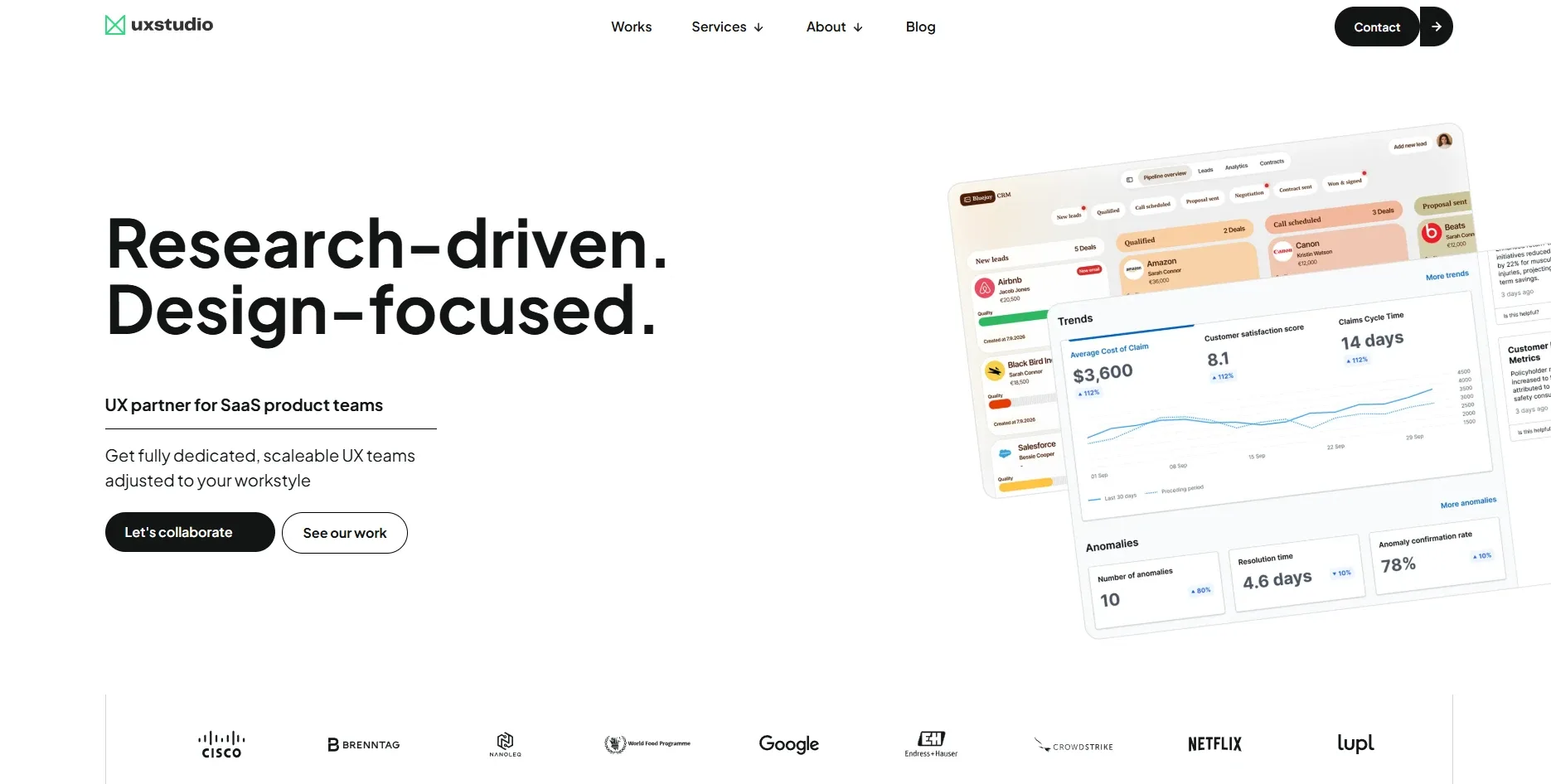
UX Studio is a Budapest-based product design agency that treats research and design as separate, specialized disciplines. Most agencies blend them together. UX Studio keeps them distinct, and the result is design decisions that are backed by actual user behavior, not assumptions.
Why they made this list:
- They offer enterprise-level usability testing at rates that work for growth-stage SaaS teams
- Hourly rates sit between $25 and $49, making them one of the most accessible research-led agencies on this list
- They treat user research and design as separate disciplines, which most agencies do not
| Strength | What it means for you |
|---|---|
| B2B SaaS focus | They know dashboards, complex flows, and multi-role interfaces |
| User research depth | Every decision is tested with real users before it ships |
| Dashboard simplification | They take messy, overbuilt products and make them usable |
Limitation: UX Studio is a UX and UI firm. They do not handle backend development or brand marketing. You will need a separate partner for those.
Verdict: If you are a product manager who needs to justify every design decision with real data, UX Studio is a strong match. The price point makes them accessible at the scaling stage.
6. Ramotion: Best For B2B Design Systems
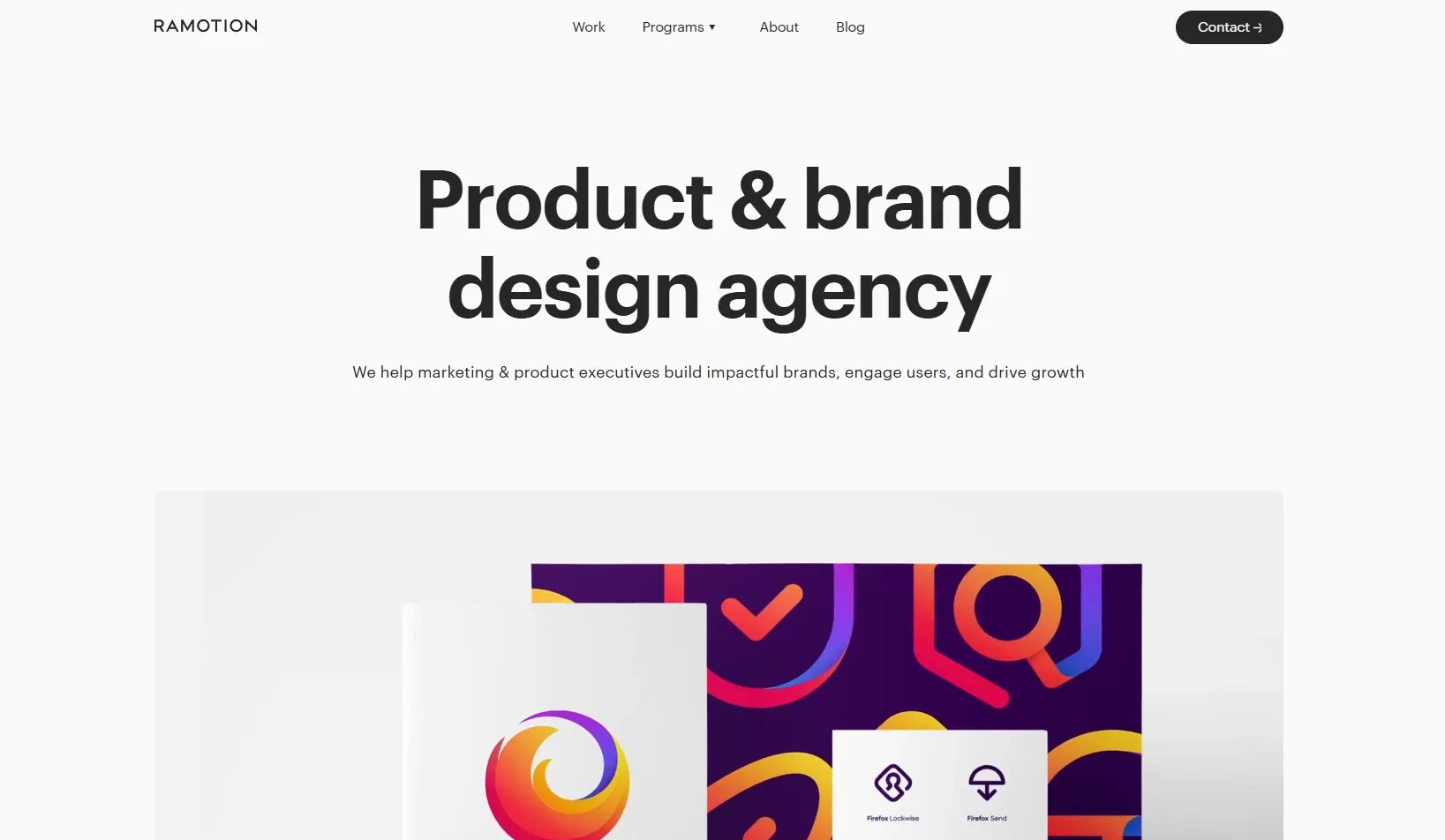
Ramotion is a San Francisco-based agency with a client list that includes Netflix, Mozilla, Adobe, Salesforce, Okta, Stripe, and Xero. They specialize in building design systems that scale, so your product looks consistent whether you have 10 screens or 1,000.
Why they made this list:
- Turo's support portal redesign led to a 30% improvement in users finding answers
- Puzzle.io grew 15% month over month after working with Ramotion
- Truebill was acquired by Rocket Money following Ramotion's branding work
- Their Salesforce Lightning Design System work improved efficiency across millions of users
Limitation: Some clients have noted a slower delivery pace. Quality stays high, but if your team runs fast sprint cycles, the timeline may not always match your rhythm.
Verdict: For established tech companies that need to professionalize their visual language and create a design system that holds up at scale, Ramotion is one of the best options available. Rate: $150 to $199 per hour.
7. IDEO: Best For Human-Centered Strategy and Innovation
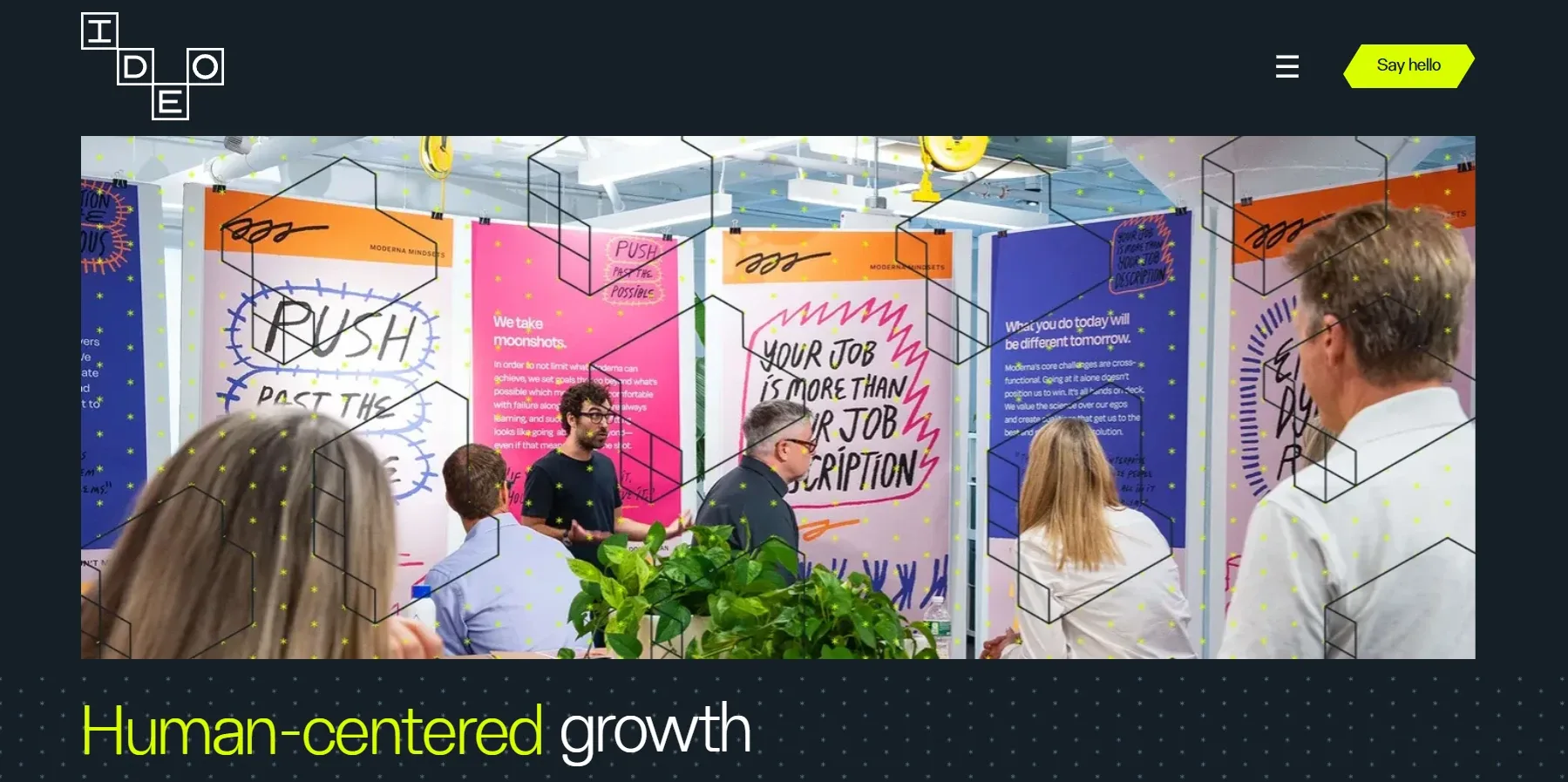
IDEO invented design thinking as a formal methodology. While most agencies focus on screens, IDEO focuses on the human behavior behind the screens. In 2026, they lead work on ethical AI design and social-impact products.
Why they made this list:
- IDEO invented design thinking as a formal methodology and still leads the field
- In 2026, they are at the front of ethical AI design and social-impact products
- They work at the strategy layer, helping teams figure out what to build before a single screen gets drawn
They are best at high-level product strategy, service design, and figuring out how a digital product fits into real physical environments.
Limitation: IDEO can feel too conceptual for teams that need to ship quickly. You may walk away with a sharp strategy but still need a separate agency to build the actual product.
Verdict: Hire IDEO when you need to understand the problem deeply before building anything. If you already know what to build, look elsewhere on this list.
8. Instrument: Best For Brand Storytelling and Digital Campaigns
Instrument is a Portland-based creative agency, now part of Stagwell, that sits between marketing and product craft. Their work for Nike and Pinterest shows what happens when brand narrative and digital experience are built as one thing rather than two separate projects.
Why they made this list:
- Their work for Nike and Pinterest shows what happens when brand narrative and product experience are built as one
- Instrument creates products where the brand story and the digital experience evolve together
- That combination is genuinely rare, and it shows in how their work performs culturally
They are strong at interactive storytelling, experimental UI, and products where emotional connection is part of the value. Think consumer apps, lifestyle brands, and cultural products.
Limitation: Instrument leans more toward marketing than raw utility. If your product needs to be powerful and efficient above all else, a firm like Work & Co or UX Studio will serve you better.
Verdict: For lifestyle, fashion, and consumer brands where the story around the product matters as much as the product itself, Instrument is the right choice.
9. Frog: Best For Physical-Digital Integration and Iot
Frog has a 50-year history that includes designing the first Apple computers. Now part of Capgemini Invent, they lead in what they call "connected experiences," meaning products that live across both physical hardware and digital interfaces.
Why they made this list:
- Frog has 50 years of experience, including designing the first Apple computers
- They are the deepest specialist on this list for IoT, wearables, medical devices, and connected hardware
- No other agency here has the same physical-to-digital design history
They are good at industrial design, IoT interfaces, and sustainable design for hardware companies moving into the digital space.
Limitation: Being part of Capgemini means more corporate structure than a boutique agency. Some clients find the process slower and more layered as a result.
Verdict: For hardware startups and industrial companies building digital interfaces for physical products, Frog is the go-to. If your product is purely software, another agency will be a faster fit.
10. Presta: Best For Agentic AI and Startup Growth
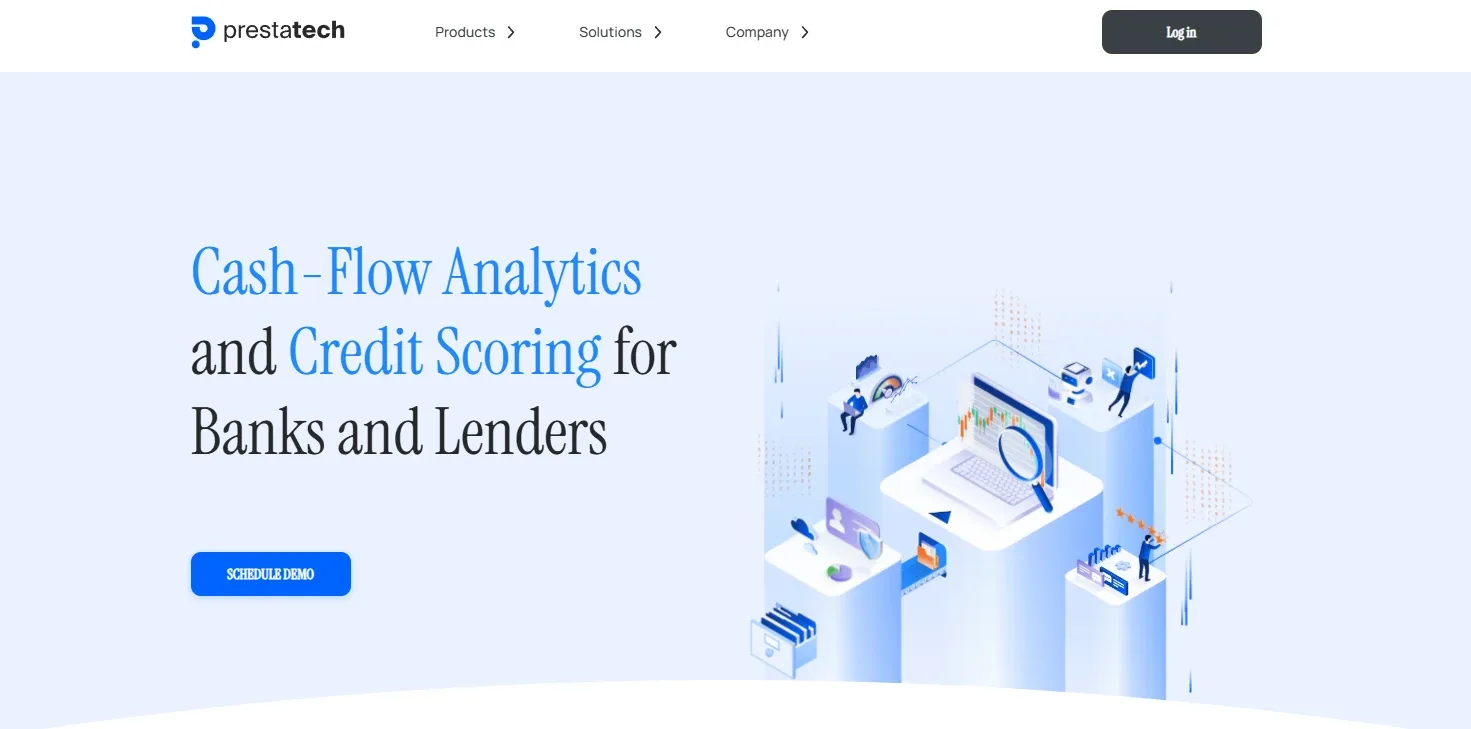
Presta is a newer, smaller agency focused on the frontier that most established firms have not caught up to yet: AI agents and autonomous interfaces. They design UI for AI that does things, not just AI that says things.
Why they made this list:
- In 2026, most digital product design agencies are still designing for traditional software patterns
- Presta is one of the few actively building interaction models for agentic AI products
- Their focus is UI for AI that does things, not just AI that says things
Limitation: Presta runs a team of approximately 15 to 20 people. They do not have the bandwidth for massive multi-year enterprise programs. Large scope projects will stretch them thin.
Verdict: If you are an AI founder who needs a lean, focused team that understands the current tech stack, Presta is the top choice. For anything beyond an MVP or Series A product build, pair them with a larger partner.
How to Choose the Right Digital Product Design Agency

The right agency depends on one thing: what problem are you actually trying to solve right now?
Match your stage to the right partner:
Table:
| Your situation | Best fit |
|---|---|
| Pre-launch or MVP | UX Studio or Presta |
| Scaling SaaS with ongoing needs | Ramotion or UX Studio |
| Fundraising or investor-ready design | Clay or MetaLab |
| Regulated industry (HIPAA, GDPR) | Work & Co or Frog |
| Fortune 500 digital transformation | Work & Co |
| Brand and product storytelling | Instrument or Ramotion |
| Agency needing a white label design partner | Panze |
Three Bad Habits to watch for:

No product design case studies. A strong landing page portfolio is not the same as experience with dashboards, onboarding flows, or role-based permissions. Ask to see the post-login experience.
Case studies with no numbers. Good product design moves real metrics. Clay, MetaLab, and Ramotion all publish specific outcomes. Hold every agency to that standard.
No direct access to your designer. If every conversation routes through a coordinator, slow delivery follows. Ask upfront who you will actually talk to each week.
Final Thoughts
The best digital product design agency for you is not the most famous name on this list. It is the one that fits your current stage, your budget, and the exact problem your product is facing right now.
And if you run an agency, studio, or consultancy and need a white label digital product design partner for SaaS and app work, Panze is built exactly for that. They work under your brand, inside your workflow, and deliver product design your clients will trust without ever knowing Panze was involved.
Visit panze.co to start the conversation.
Frequently Asked Questions
What is a digital product design agency?
A digital product design agency specializes in designing software products and digital experiences. This includes onboarding flows, dashboards, mobile apps, and everything a user interacts with after they log in. It is different from a general web design agency, which focuses on marketing sites before a user signs up.
How much does digital product design cost in 2026?
Hourly rates run from $25 to $199 depending on the agency and their location. Monthly retainers at embedded agencies start around $3,000 to $5,000 per month. Fixed project engagements start at $10,000 for boutique agencies and go to $100,000 or more for top-tier studios like MetaLab and Clay.
What is a white label design agency?
A white label design agency does the work invisibly. The agency that hired them presents the work to their own client under their own brand. Panze works this way exclusively, under NDA, for agencies and studios that need SaaS and app design capacity on demand.
Should I hire a digital product design agency or build an in-house team?
For early-stage teams, an agency gives you senior expertise without a long hiring process. For fast-scaling teams, in-house designers build deeper product knowledge over time. Many companies use agencies during key growth phases and move to internal teams once the product is stable.
How do I evaluate a digital product design agency before hiring?
Ask them to walk you through a case study in your exact vertical. Look for specific numbers. A good agency tells you what problem they solved and what changed after launch. If the answer skips the metrics, keep looking.
What is the difference between product design and marketing design?
Product design covers everything after login: dashboards, onboarding, settings, and data views. Marketing design covers everything before sign-up: landing pages and ads. Confusing the two leads to hiring the wrong agency. MetaLab, Clay, and UX Studio handle the product side. Instrument handles marketing-leaning work.